
Introduction: The Evolution of Excellence
In the early days of Six Sigma, back in 1979, the focus was very narrow: reduce defects. If you were a manufacturer making 1,000 widgets and 100 were broken, you had a “quality” problem. You used statistics to figure out why they were breaking and you fixed the machine. But as the global market became more complex, organizations realized they could have “zero defects” and still go bankrupt. Why? Because they were wasting too much time, space, and movement.
This realization led to a massive evolution in how we think about business. It wasn’t enough to be “accurate”; you had to be “fast” and “innovative” too. This gave rise to three distinct but connected powerhouses: DMAIC, Lean Six Sigma (LSS), and Design for Six Sigma (DFSS). To the uninitiated, these look like academic buzzwords. To a certified professional, they are the primary tools for ensuring an organization doesn’t just survive, but thrives.
1. DMAIC: The Shield for Your Profit Margin
The classical DMAIC approach (Define, Measure, Analyze, Improve, Control) is about precision. It is data-intensive and fully oriented with statistical principles. Its main goal is to reduce variability. In simple terms, if your customers expect a “perfect” experience every time they call your help desk or use your product, DMAIC ensures you deliver it.
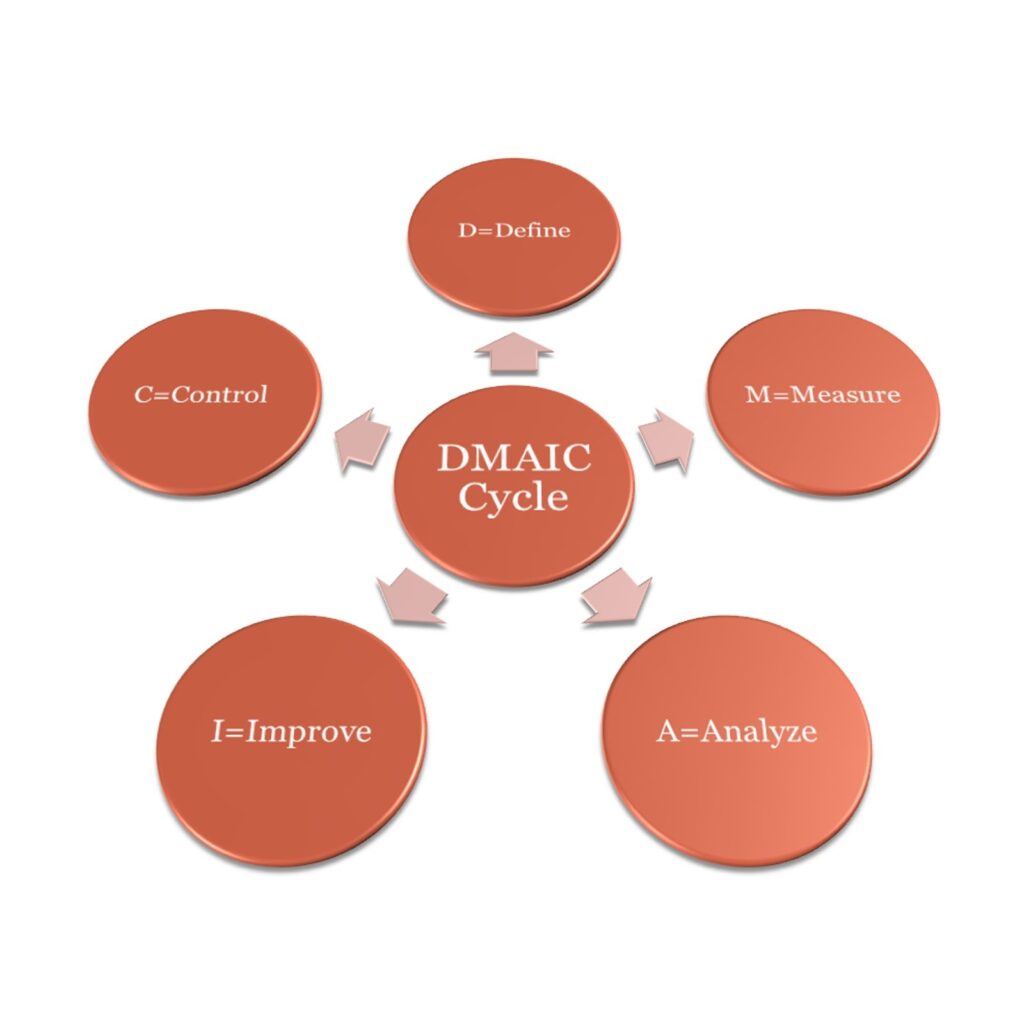
When a process is unstable, it eats your profit margin. Every time a worker has to redo a task, or a customer returns a faulty product, that is “Cost of Poor Quality.” DMAIC acts as a shield, protecting your bottom line by bringing unsteady processes under control. As Harry and Schroeder famously proposed, reaching a “Six Sigma” level means having fewer than 3.4 defects per million opportunities. It’s about being as close to perfect as humanly possible.
2. Lean Six Sigma: The Engine of Cash Flow
While DMAIC focuses on the “quality” of the output, Lean focuses on the “flow” of the process. Borrowing from the legendary Toyota Production System, Lean is all about identifying and removing waste. Waste can be anything: excess inventory sitting in a warehouse, unnecessary movement of people, or even “over-processing” a product beyond what the customer actually wants.
When you combine Lean with Six Sigma (LSS), you get the best of both worlds. LSS doesn’t just reduce defects; it speeds up delivery performance. Many CEOs prefer Lean Six Sigma because it demonstrates immediate “Cash-Flow” benefits. While a deep statistical DMAIC project might take months to show results, a Lean project that clears a bottleneck on the factory floor can put money back in the company’s pocket next week. As Michael George noted in his 2002 book, LSS is the bridge between waste reduction and defect reduction.
3. DFSS: Designing the Future (Top-Line Growth)
Eventually, world-class organizations like General Electric realized a frustrating truth: it is very expensive to keep “fixing” old, bad processes. They started asking a revolutionary question: “Can we avoid these defects from the very beginning?”
This is where Design for Six Sigma (DFSS) comes in. Unlike DMAIC, which “improves” what already exists, DFSS “creates” what doesn’t exist yet. Using the DMADV approach (Define, Measure, Analyze, Design, Verify), DFSS focuses on the research and development stage.
If you design a product correctly from day one, you don’t need a massive team of Green Belts to fix it later. DFSS is about “Top-Line” improvement. It allows a company to launch new, innovative products that are “insulated” from defects and waste throughout their entire life cycle. It protects the business from the birth of the product, ensuring that the customer gets exactly what they need without the “inherited crisis” of poor design.
The Power of Integration: The “Mother Initiative” The real secret to sustainable growth isn’t choosing just one of these methods. It’s about Integration. An organization is like a high-performance vehicle.
In our Master Black Belt and leadership courses, we teach students how to synergize these multiple initiatives under one integrated structure. We look at the “Joiner Triangle,” which emphasizes that you need quality tools, a scientific approach, and “All-in-One” teamwork. When these three things work together, reliability and availability improvement become a strategic advantage.
Conclusion: Your Role in the Integrated Model The world is changing. Customers are more demanding, and costs are rising. Organizations can no longer afford to work in “silos” where the design team doesn’t talk to the maintenance team. By pursuing your Six Sigma certification—whether it’s a Yellow, Green, or Black Belt—you are preparing yourself to be the “glue” that holds these strategies together.
You are learning how to look at a business as a whole system. You are learning to distinguish between a “defect problem” (solved by DMAIC), a “waste problem” (solved by Lean), and a “design problem” (solved by DFSS). This horizontal connectivity is what makes a professional indispensable. The goal of our training isn’t just to teach you math; it’s to give you the tools to ensure sustained growth, improved reliability, and a protected future for your career and your company.

Leave a Reply